WORTH ITFor the bunker. DEPENDS for the upstairs.
Quick answer
Go, but go down first. Visitors rate it clearly below the War Remnants Museum (the reviews are here), and the gap is the honest story: the upstairs is sparse. The basement command bunker, with its 1970s radio banks and war-room map tables, is the part that cannot be seen anywhere else. Most visitors do the grand reception rooms first, run out of energy and heat tolerance, and rush it. The palace-only ticket is 40,000₫.
Book it
Which ticket should you buy?
Palace only at 40,000₫ for most people. The 80,000₫ combined ticket adds the separate exhibition hall, which is worth it for history readers and skippable for everyone else.
This tariff has applied since 1 August 2025, per the palace's Vietnamese-language page (its English page shows the same prices dated 1 May 2026). One trap: the 65,000₫ figure many guides quote is, on the current tariff, the palace-plus-buggy combo — it does not include the exhibition hall.
| Ticket | Adult | Seniors 60+ / VN students | Children |
|---|---|---|---|
| Palace only | 40,000₫ (US$1.54) | 20,000₫ (VN students; seniors not listed) | 10,000₫ |
| Palace and exhibition | 80,000₫ (US$3.08) | 40,000₫ | 20,000₫ |
| Palace and buggy | 65,000₫ (US$2.50) | 45,000₫ | 35,000₫ |
| Palace, exhibition and buggy | 105,000₫ (US$4.04) | 65,000₫ | 45,000₫ |
| Electric buggy tour of the grounds | 25,000₫ per person per ride | — | — |
Plan your visit
- Entrances
- 135 Nam Kỳ Khởi Nghĩa (main) and 106 Nguyễn Du
- How long
- 1–1.5 hours; up to 3 with the exhibition hall
- Cameras
- Tell the ticket staff if you bring a camera; drones are banned, and wedding or commercial shoots need a paid permit (from 1 August 2026)
- Guide at the gate
- 250,000–380,000₫ per group (US$9.60–14.60) as quoted in August 2026 — or buy entry ahead
- Address
- 135 Nam Kỳ Khởi Nghĩa (former District 1) — open in Google Maps
For two to four people the gate guide is the best marginal spend in the city. This is the site that most rewards a narrator, because the labels will not do it for you — the most common piece of advice in the review record is to read up on the Fall of Saigon beforehand, which is a polite way of saying the interpretation is thin.
What happened here on 30 April 1975?
North Vietnamese tanks reached the palace late that morning, a flag went up over the balcony, and President Dương Văn Minh surrendered in the reception room.
Two tanks sit on the front lawn, and there is a genuinely good argument attached to the pair they stand in for. Tank 390, a Chinese-built Type 59, broke through the main gate; tank 843, a T-54B, got stuck at a side gate — but 843's commander, Bùi Quang Thận, was the man who ran up and raised the flag. Which tank actually broke the gate was argued over for decades, and the more famous one is not the one that did it. The lawn tanks are not the originals: 390 and 843, declared national treasures in 2012, are in museums in Hanoi.
Three weeks earlier, on 8 April 1975, a defecting South Vietnamese pilot bombed the palace in an F-5E. The impact point is marked on the roof, near the Huey helicopter that sits on the helipad.
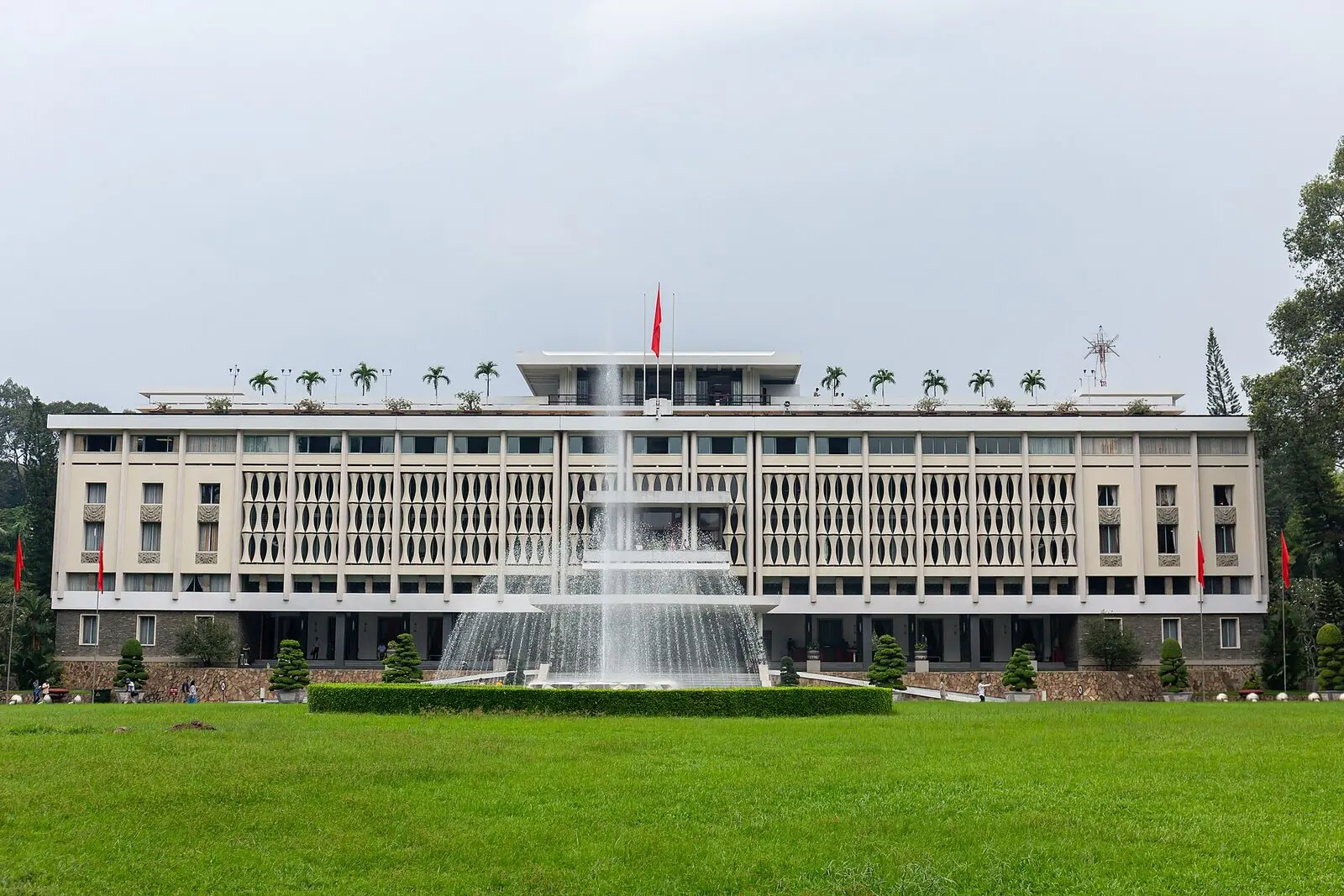
The building itself is younger than most visitors assume and is not a colonial one. Its predecessor, Norodom Palace, was bombed in February 1962 by two rogue South Vietnamese air force pilots; the current building, by the architect Ngô Viết Thụ, was completed in 1966 and is a significant piece of Vietnamese modernism.
A walk through the palace interior. It gives you an honest sense of how sparse the upstairs rooms are. Video by Ninja Teacher.
The bunker
A basement command level with 1970s telecommunications banks, war-room map tables, the president's bedroom and kitchen, and escape corridors.
Go straight down before you go up. That single piece of sequencing is the difference between an ordinary visit and a memorable one, because the palace is large, hot in parts, and involves a great deal of walking through corridors that are much less interesting than the basement.
If the bunker is the thing you came for, there is a sequel about 400 m away. The Ho Chi Minh City Museum, the former Gia Long Palace, sits on a 1,400 m² bomb shelter built between May 1962 and October 1963 for President Ngô Đình Diệm. Ngô Viết Thụ — the palace's architect — was given the design, but left for the US and the engineer Phan Đình Tăng finished it. It has six cast-iron doors with ship's-wheel locks, and it reopened at the end of March 2026 after six months of repairs, with all four entrances open and about 150 m of it now walkable.
In March the museum ticket included the bunker. That ticket rose from 30,000₫ to 60,000₫ (about US$2.31) on 1 October 2026, with children and students free.
What people complain about
Thin interpretation, a lot of walking, limited air-conditioning, and buying the wrong ticket.
- One recurring review line calls the interior somewhat pedestrian — a mid-century modern building, and not much more, if you skip the basement.
- Several complaints come from visitors who paid and then discovered they were only walking the grounds. Confirm interior access at the window.
- The corridors are long and the air-conditioning is partial. Carry water.
- 30 April and 1 May are a hard-avoid window. Reunification Day plus Labour Day is now the peak domestic-travel crush, and this palace is its centre.
Who this is for
Tickets and guided options
You can buy at the gate. Skip the window queue if you would rather not stand in the sun.
GetYourGuide
Entry tickets and city tours that include the palace with a narrator.
Browse
See on GetYourGuideOpens getyourguide.com
TripAdvisor
The palace's review page, and visitors' bunker photographs.
Read reviews
See on TripAdvisorOpens tripadvisor.com
Some links are affiliate links — they don't change your price and keep this guide running.
Questions people actually ask
Is Independence Palace worth visiting?
How much are Independence Palace tickets?
How long do you need?
Sources — checked 5 October 2026
- Independence Palace (Vietnamese) — full tariff and combos, applied from 1 Aug 2025
- Independence Palace (English) — tariff, both entrances
- Independence Palace — photography rules and permits from 1 Aug 2026
- Wikipedia — 1962 bombing, 1962–66 construction, 8 April 1975 strike, 30 April 1975
- VnExpress — tanks 390 (Type 59) and 843 (T-54B), now in Hanoi museums; national treasures 2012
- VnExpress, 31 Mar 2026 — HCMC Museum bunker reopened after six months' repairs
- Ho Chi Minh City Museum — 60,000₫ fee from 1 Oct 2026, exemptions